
Louis Cyuzuzo (University of Manchester)
Date Thu, 11 June 2026, 6:15 p.m.
Location PEG 1.G191, Westend Campus
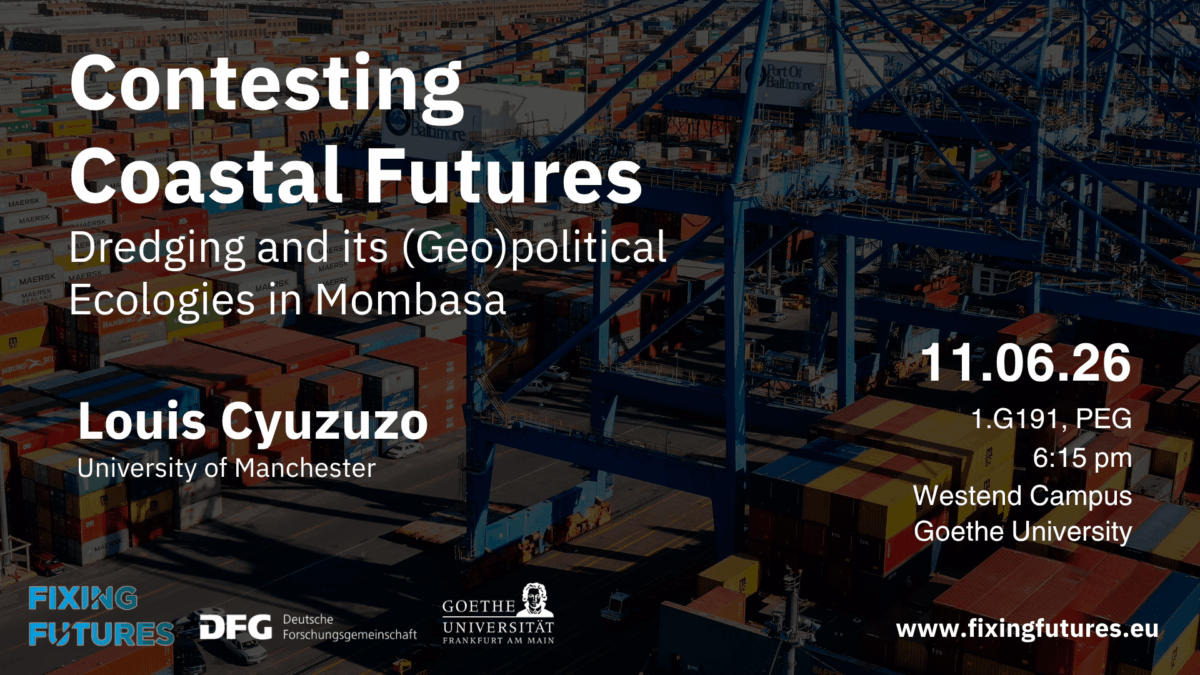
This presentation will examine the political-ecological effects of the construction of Phase 2 of Mombasa Port’s Second Container Terminal (2CT), a project which, while largely understudied, has been a key part of Kenya’s infrastructure and logistics modernization throughout the last decade. Implemented as part of the Mombasa Port Development Program in cooperation with the Japan International Cooperation Agency (JICA), the 2CT is a flagship project of Kenya’s Vision 2030 for development. However, the 2CT has raised important environmental concerns for residents of the Southern Coast of Mombasa, most notably regarding the environmental impacts of sand harvesting conducted for the project’s land reclamation phase in 2019.
The presentation will specifically center on the ecological uncertainties generated by sand harvesting and how they crystallized an ‚epistemic rift‘ shaped by competing representations of Mombasa’s coastal landscapes. Building on a multidisciplinary perspetive that includes political ecology, political economy, and STS, I foreground two main representations of coastal landscapes that tie to long-standing and emerging relations of territorial power on the Kenyan coast: one privileged by dominant domestic and foreign state and non-state actors pursuing various strategic objectives who envision coastal landscapes as exploitable spaces of logistics circulation, and the other present among peripheral and marginalized
communities in Mombasa who see coastal landscapes as endangered spaces of preservation.
The presentation will focus on demonstrating how these representations have had cascading effects on different levels of political contestation, including knowledge controversies over the impacts of sand harvesting, rent and economic distribution conflicts regarding coastal land-use, and competing visions of what coastal development means. Broadly speaking, this work advances a way of thinking about the effects of ongoing spatial development strategies in port cities through the study of dredging, a form of infrastructure intervention that remains understudied, particularly along the African littoral. It contributes to an emerging critical literature that demonstrates how dredging and sand extraction play an increasingly important role in the transformation of port cities and coastal landscapes, where the imperatives of infrastructure-led (urban) development, global logistics integration, and geopolitical competition trigger complex and unpredictable coastal ecological shifts, with important implications for communities’ livelihoods, place-making, and coastal futures.
Bio
Louis Cyuzuzo | PhD Researcher | Global Development Institute | School of Education, Environment and Development (SEED) | University of Manchester.
Recent publications:
Cyuzuzo, L. (2026). Shifting sands and ecological uncertainties: An urban political ecology of dredging in Mombasa. Environment and Planning E: Nature and Space, 0(0).
https://doi.org/10.1177/25148486261420090